
Petrol price unchanged at Rs321.17 per litre
The government kept petrol and diesel prices unchanged despite rising global oil prices to ease pressure on consumers.
The Government of Pakistan on Friday decided to maintain existing petroleum prices, keeping petrol at Rs321.17 per litre and high-speed diesel at Rs335.86 per litre, according to a press release issued by the Ministry of Energy (Petroleum Division).
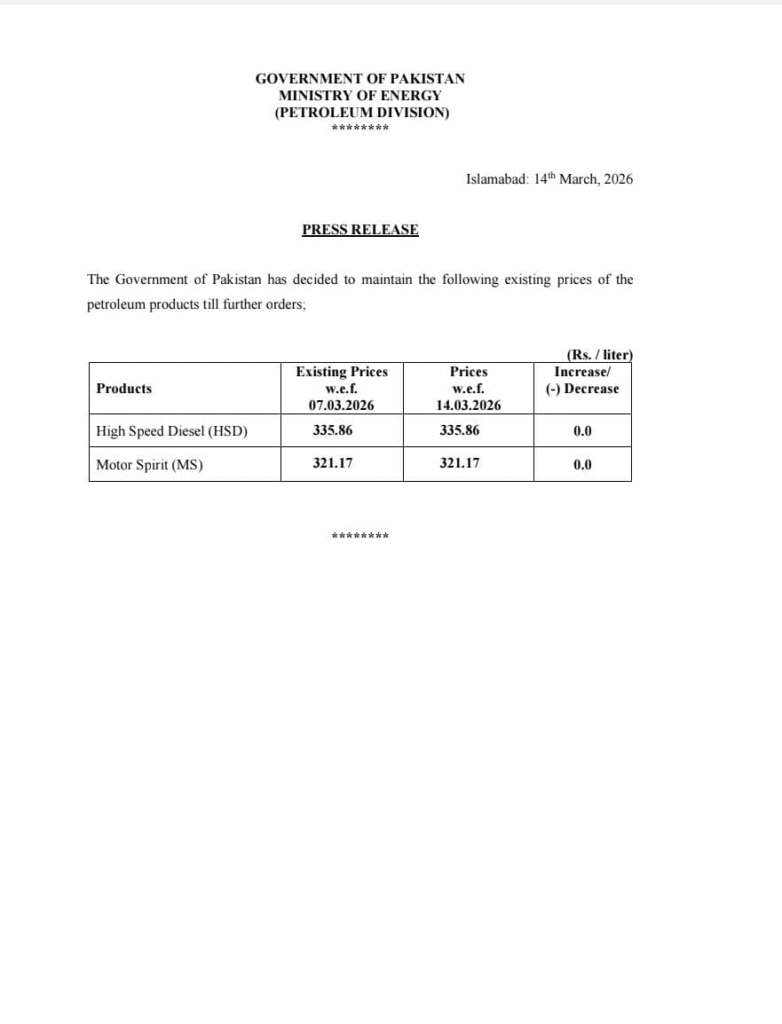
The notification confirmed that the prices would remain effective from March 14 until further orders, with no increase or decrease announced for either product. The decision means the price of Motor Spirit (MS), commonly known as petrol, will stay at Rs321.17 per litre, while High-Speed Diesel (HSD) will remain at Rs335.86 per litre, unchanged from the rates announced on March 7.
Prime Minister Shehbaz Sharif decided not to increase petroleum prices despite an uptick in global oil markets. According to a statement issued by the Prime Minister’s Office, the premier said the decision was taken to reduce the financial burden on the public.
He said the government would continue providing relief to citizens as much as possible in line with its commitments. The prime minister noted that the global economy was under pressure due to regional tensions, which could have significant implications for Pakistan’s economy.
Pakistan relies heavily on imported petroleum products, making domestic fuel prices sensitive to international oil market fluctuations and exchange rate movements. Fuel prices are typically reviewed every fortnight based on global oil prices and recommendations from the Oil and Gas Regulatory Authority (OGRA).
The government reviews petroleum prices twice a month, adjusting rates according to global crude oil trends, exchange rates, and domestic taxation policies. Any increase or decrease directly affects transportation costs, electricity generation expenses, and overall inflation across the economy.
Officials said the government had opted to absorb the impact of rising global prices to protect consumers and businesses from additional financial strain. The prime minister emphasized that timely policy decisions, austerity measures, and financial discipline were helping the government manage external economic pressures.
He added that provincial governments were supporting the federal government’s austerity efforts, describing the cooperation as a positive step toward stabilizing the economy. The premier also said that diplomatic and economic teams were working to ensure adequate crude oil supplies to meet the country’s needs.
Authorities are also monitoring fuel distribution across the country to prevent overcharging or hoarding by retailers. The federal and provincial governments are coordinating to ensure that consumers are not charged more than the official prices set by the government.
The decision comes only a week after the government increased petrol and diesel prices following disruptions in global oil supply linked to tensions in the Middle East and the conflict involving Iran. The situation had created uncertainty in international energy markets and pushed crude prices higher.
Officials said the government had already introduced austerity measures to manage the economic impact of supply disruptions and rising energy costs. These measures aim to control spending and ensure that essential imports such as crude oil remain available.
Sources said Prime Minister Shehbaz Sharif had earlier informed a consultative meeting attended by federal and provincial representatives that after an initial Rs55 per litre increase, the government would avoid further hikes in the near term regardless of developments in the Middle East.
According to officials present at the session, the meeting was also attended by Chief of Defence Forces Field Marshal Asim Munir. The prime minister reportedly said the government would rely on emergency block allocations to absorb additional price pressures if global oil prices continued rising.
He warned that the current situation caused by fuel supply disruptions and geopolitical tensions posed one of the most serious economic challenges facing the country. However, he expressed hope that the global situation would improve and petroleum prices would stabilize in the coming weeks.
Petrol price unchanged at Rs321.17 per litre
The government kept petrol and diesel prices unchanged despite rising global oil prices to ease pressure on consumers.
The Government of Pakistan on Friday decided to maintain existing petroleum prices, keeping petrol at Rs321.17 per litre and high-speed diesel at Rs335.86 per litre, according to a press release issued by the Ministry of Energy (Petroleum Division) in Islamabad on March 14, 2026.
The notification confirmed that the prices would remain effective from March 14 until further orders, with no increase or decrease announced for either product. The decision means the price of Motor Spirit (MS), commonly known as petrol, will stay at Rs321.17 per litre, while High-Speed Diesel (HSD) will remain at Rs335.86 per litre, unchanged from the rates announced on March 7.
Prime Minister Shehbaz Sharif decided not to increase petroleum prices despite an uptick in global oil markets. According to a statement issued by the Prime Minister’s Office, the premier said the decision was taken to reduce the financial burden on the public.
He said the government would continue providing relief to citizens as much as possible in line with its commitments. The prime minister noted that the global economy was under pressure due to regional tensions, which could have significant implications for Pakistan’s economy.
Pakistan relies heavily on imported petroleum products, making domestic fuel prices sensitive to international oil market fluctuations and exchange rate movements. Fuel prices are typically reviewed every fortnight based on global oil prices and recommendations from the Oil and Gas Regulatory Authority (OGRA).
The government reviews petroleum prices twice a month, adjusting rates according to global crude oil trends, exchange rates, and domestic taxation policies. Any increase or decrease directly affects transportation costs, electricity generation expenses, and overall inflation across the economy.
Officials said the government had opted to absorb the impact of rising global prices to protect consumers and businesses from additional financial strain. The prime minister emphasized that timely policy decisions, austerity measures, and financial discipline were helping the government manage external economic pressures.
He added that provincial governments were supporting the federal government’s austerity efforts, describing the cooperation as a positive step toward stabilizing the economy. The premier also said that diplomatic and economic teams were working to ensure adequate crude oil supplies to meet the country’s needs.
Authorities are also monitoring fuel distribution across the country to prevent overcharging or hoarding by retailers. The federal and provincial governments are coordinating to ensure that consumers are not charged more than the official prices set by the government.
The decision comes only a week after the government increased petrol and diesel prices following disruptions in global oil supply linked to tensions in the Middle East and the conflict involving Iran. The situation had created uncertainty in international energy markets and pushed crude prices higher.
Officials said the government had already introduced austerity measures to manage the economic impact of supply disruptions and rising energy costs. These measures aim to control spending and ensure that essential imports such as crude oil remain available.
Sources said Prime Minister Shehbaz Sharif had earlier informed a consultative meeting attended by federal and provincial representatives that after an initial Rs55 per litre increase, the government would avoid further hikes in the near term regardless of developments in the Middle East.
According to officials present at the session, the meeting was also attended by Chief of Defence Forces Field Marshal Asim Munir. The prime minister reportedly said the government would rely on emergency block allocations to absorb additional price pressures if global oil prices continued rising.
Read More: Govt Raises Petrol, Diesel Prices by Rs55
He warned that the current situation caused by fuel supply disruptions and geopolitical tensions posed one of the most serious economic challenges facing the country. However, he expressed hope that the global situation would improve and petroleum prices would stabilize in the coming weeks.
The government’s decision to keep petrol and diesel prices unchanged is expected to provide temporary relief to consumers and transport sectors already dealing with high inflation and rising living costs.
PPDA warns petrol pumps may shut from March 27
Petroleum dealers threaten nationwide shutdown if government refuses to raise margin to 8%.
The Pakistan Petroleum Dealers Association (PPDA) has warned that petrol pumps across the country may shut down indefinitely from March 27 if the government does not increase the dealers’ margin to 8%, escalating tensions between fuel retailers and authorities over declining profitability.
Speaking at an emergency press conference at the Karachi Press Club on Friday, PPDA Chairman Abdul Sami Khan said petroleum dealers were prepared to resist if the government failed to honor its commitment regarding dealer margins.
He said the government had earlier promised an eight percent margin for petrol pump operators, but the current margin had dropped significantly due to rising petroleum product prices. According to Khan, the margin has effectively fallen to around 2.68%, making it increasingly difficult for dealers to continue operating their businesses.
He urged authorities to immediately address the issue and revise the dealer margin structure. Khan warned that if the demand was not accepted, petrol pump operators across Pakistan would suspend fuel sales nationwide starting March 27.
Petroleum dealers argue that the current margin does not cover operational costs such as electricity, employee salaries, security, and maintenance. Rising fuel prices have also increased working capital requirements for petrol pump operators, placing additional financial pressure on small and medium-sized dealers.
PPDA Vice Chairman Tariq Hassan also raised concerns about a potential increase in fuel prices in the coming days. He claimed that petrol prices could rise by Rs50 to Rs60 per litre due to developments in the global oil market and regional tensions affecting supply chains.
Another association official, Waseem Qadri, said dealers were seeking a margin of eight percent to make their businesses sustainable. He explained that under the current structure, dealers earn roughly Rs8 per litre, but if the margin were fixed at eight percent, earnings could increase to around Rs25 per litre.
Fuel retailers said the margin revision was essential for the survival of petrol pumps, particularly smaller outlets operating in rural and semi-urban areas where sales volumes are lower. Dealers warned that without a revision in margins, many petrol stations could face closure due to mounting operational costs.
Petroleum dealers also alleged that smuggled Iranian petrol and diesel were still widely available in various parts of the country, particularly in border regions. They said the continued presence of smuggled fuel was undermining the formal petroleum market and hurting legitimate dealers who pay taxes and comply with regulatory requirements.
The issue of fuel supply has also raised concerns among petrol pump operators in recent weeks. On March 4, the All-Pakistan Petrol Pump Owners Association warned of a potential shortage of petroleum products and called for immediate government intervention.
In a letter addressed to the prime minister, the association alleged that oil marketing companies had imposed a quota system that limited the amount of fuel supplied to petrol pumps. The letter claimed that many stations were not receiving the quantities they had ordered.
The association further stated that even when supplies were approved, tanker deliveries were often delayed for several hours, causing operational disruptions for petrol pumps and inconvenience for consumers.
Industry representatives cautioned that such supply constraints could create an artificial shortage of petroleum products in the market. They warned that any perception of limited supply could trigger panic buying among consumers and disrupt normal fuel distribution across the country.
Pakistan’s petroleum pricing and supply system relies heavily on imports, making the domestic market sensitive to international crude oil prices, exchange rate fluctuations, and regional geopolitical developments.
Fuel prices are typically reviewed every fortnight based on recommendations from the Oil and Gas Regulatory Authority (OGRA), which considers global oil prices, shipping costs, and currency movements when determining adjustments.