

Pakistan LNG reserves may run out in days: Chairman Associated Group
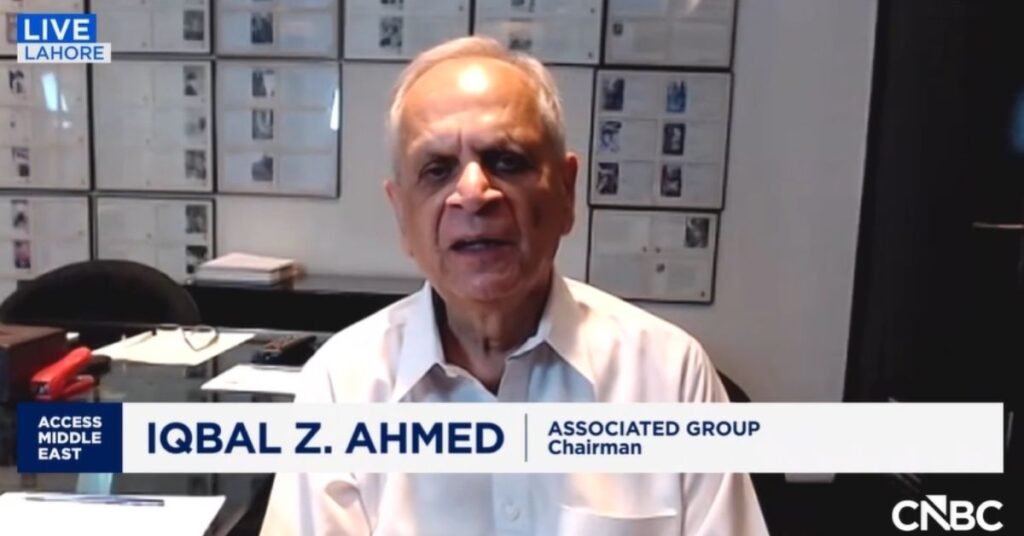
Floating LNG storage could empty within a week as supply disruptions raise energy concerns.
Pakistan’s floating liquefied natural gas (LNG) storage facilities could run out of gas within seven to eight days if new cargoes fail to arrive, raising concerns over short-term fuel availability for power generation and industry.
Chairman Associated Group Iqbal Z Ahmed said that the system said the country’s floating storage and regasification units (FSRUs) currently hold limited LNG inventories after supply disruptions linked to tensions in the Middle East and halted shipments from Qatar, Pakistan’s main supplier. Ogra Notifies LNG Prices for November 2025
The warning was highlighted in a CNBC interview with Chairman Associated Group, who said existing stocks could last only about a week under current consumption patterns.
Pakistan operates two LNG import terminals at Port Qasim in Karachi, both based on floating storage and regasification units that convert imported LNG back into natural gas for domestic pipelines. These terminals have a combined regasification capacity exceeding 1.2 billion cubic feet per day and play a central role in fueling power plants and supplying industrial consumers.
The country relies heavily on imported LNG to supplement declining domestic gas reserves. Pakistan imported roughly 6.6 million tonnes of LNG in 2025, with almost all supplies sourced from Qatar under long-term contracts, according to energy consultancy Wood Mackenzie. The dependence leaves the country vulnerable to disruptions affecting shipments through the Strait of Hormuz or production facilities in the Gulf region.
Recent geopolitical tensions have amplified these risks. Analysts say attacks and shipping disruptions in the Middle East have already slowed some LNG flows from the region, forcing Asian buyers to reassess supply security.
Pakistan had already begun preparing contingency plans earlier this month after reports that QatarEnergy halted production following regional security incidents affecting shipping routes.
Authorities say emergency measures include restoring local gas production that had previously been curtailed to meet contractual LNG import obligations. Officials plan to bring back around 350 million cubic feet per day of domestic gas supply to offset potential shortages. Pakistan is also exploring additional LNG purchases from Azerbaijan’s state trading company SOCAR if demand rises unexpectedly.
Despite the immediate concern over storage levels, government officials argue the broader power system is less vulnerable than in past energy crises. According to the power ministry, about 74 percent of Pakistan’s electricity now comes from domestic sources including hydropower, nuclear plants, local coal, wind and solar generation. The share is expected to exceed 96 percent by 2034 as renewable and indigenous generation expands.
The shift toward domestic energy has reduced the role of LNG in the electricity mix. LNG currently accounts for roughly 10 percent of Pakistan’s power generation, primarily used to meet evening demand peaks when solar generation falls and electricity consumption rises.
Pakistan’s LNG import strategy has also changed significantly over the past two years. The government cancelled 21 LNG cargoes scheduled for delivery under a long-term contract with Italy’s Eni for 2026 and 2027 after rising solar generation and weaker industrial demand left the gas network oversupplied.
Energy analysts say the country has experienced a dramatic surge in rooftop solar installations, which has sharply reduced daytime electricity demand from the national grid. The power ministry estimates rooftop solar capacity has exceeded 20 gigawatts, easing reliance on gas-fired generation during daylight hours.
Even so, LNG remains critical for balancing the system during peak evening demand. If cargo delays persist for several weeks, gas shortages could still affect power generation, potentially forcing limited load shedding during the summer when electricity consumption rises due to air-conditioning.
Global LNG markets are also tightening due to supply disruptions and higher shipping costs. Analysts warn that any prolonged closure or restriction of the Strait of Hormuz could significantly reduce LNG deliveries to South Asia, where Pakistan and Bangladesh depend heavily on Gulf exporters.
Pakistan’s long-term energy policy now prioritizes indigenous resources and renewable generation to reduce exposure to volatile international gas markets. Hydropower currently produces about 40 terawatt-hours of electricity annually, while nuclear plants generate roughly 22 terawatt-hours, according to government data cited by energy officials.
In the near term, however, Pakistan’s LNG supply chain remains sensitive to disruptions. Officials say securing additional cargoes or restoring domestic gas output quickly will be crucial to avoid shortages if floating LNG storage at the country’s terminals falls to critically low levels in the coming days.