

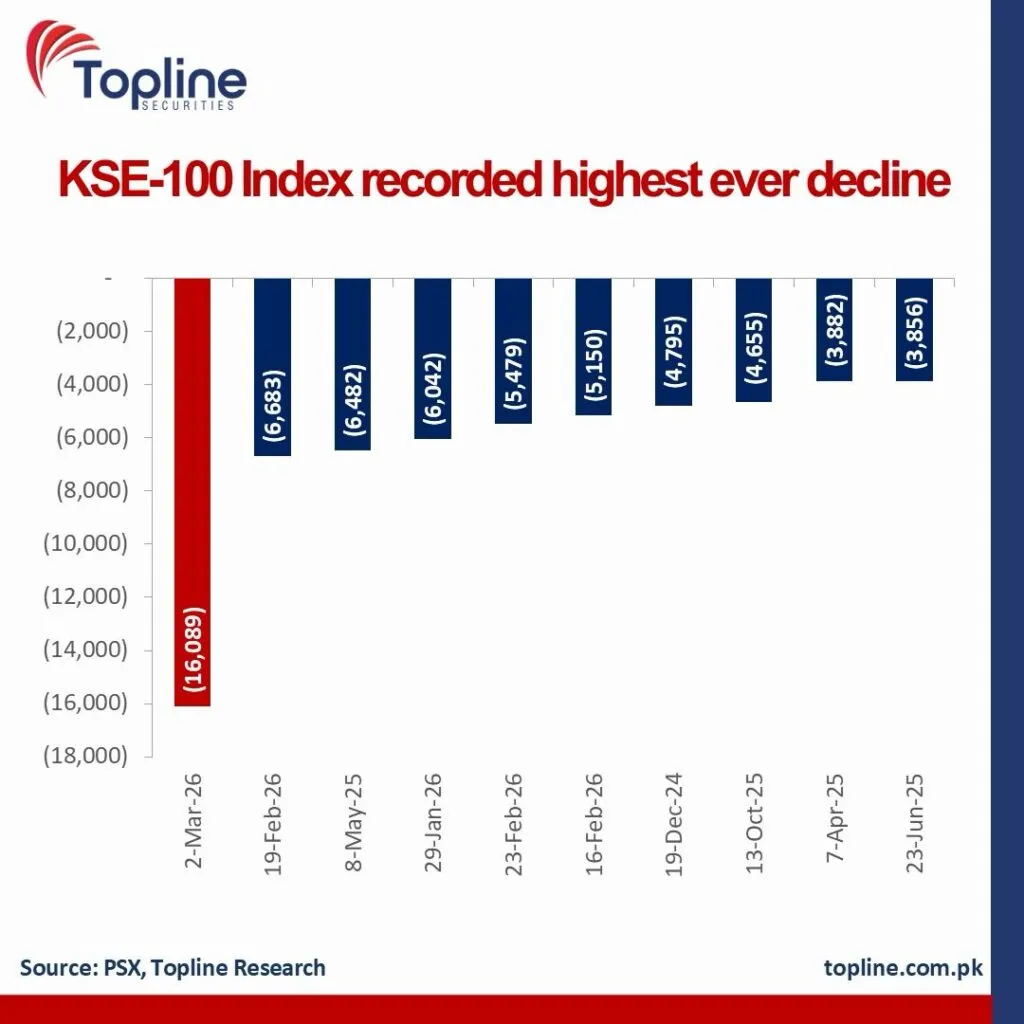
Pakistan Market Loses 16000 Points Amid War Concerns

Pakistan equities opened the session on an exceptionally bearish note, as aggressive and broad-based selling pressure gripped the market. The KSE-100 Index posted its largest-ever single-day decline, shedding 16,089 points (-9.57%) to close at 151,973 points.
The steep correction was largely driven by widespread panic selling from both retail and institutional investors, compounded by previously overbought market conditions. Amid heightened volatility, trading activity was suspended for one hour shortly after the opening bell to stabilize market conditions.
Heavyweight constituents including Fauji Fertilizer Company, United Bank Limited, Engro Holdings Limited, Hub Power Company, and Meezan Bank Limited exerted substantial downward pressure, collectively eroding 5,167 points from the benchmark index.
Despite the pronounced decline, trading activity remained elevated. Total market volume reached 809 million shares, generating a turnover of Rs. 48.5 billion. K-Electric Limited dominated the volume leaderboard, with more than 163 million shares
Pakistan market loses 9% during the first few minutes of Monday’s session amidst escalating tensions between US – Israel & Iran. The Pakistan market trading also halted for an hour as a risk management rule set by Pakistan Stock Exchange.
On Feb 28, 2026, reportedly, the duo of Israel & US carried out strikes in Iran, resulting in killing of the Supreme Leader of Iran “Syed Ayatollah Khamenei” and other top civil military leaders of the country.Stock Market Continues Momentum
In response, Iran also aggressively targeted multiple bases of the US in Middle Eastern countries namely Bahrain, UAE, Qatar, KSA and others and directly attacked Israel over the weekend.
As a result, the airspace of Middle Eastern countries is also closed and some countries/states, including Dubai, Abu Dhabi, and Kuwait, have announced suspension of their stock exchanges temporarily. The war-like situation is continuing between the duo and Iran and experts believe that the war may continue for a month.
For Pakistan, although the involvement is not direct, there are economic implications in the form of higher oil prices due to high dependence on imported oil, an increase in imported inflation, and weakening investor confidence, which could further hurt investment prospects due to hostility on both the eastern and western borders of Pakistan.
Outlook on Market: We believe that due to the evolving nature of the conflict and involvement of various countries, volatility may continue until resolution or de-escalation of the conflict. The market has already lost 19% from its high of 189k index level since Jan 23, 2026. However, any further fall in index level may provide an attractive entry point for investors as Pakistan’s recent reforms have created a decent buffer in reserves to absorb external shocks. Furthermore, the existing regime, in our view, will continue to adopt cautious policies to navigate this period.
With today’s fall, the Pakistan market has again returned to attractive levels of below 6.5x 2027 PE (Topline Universe), lower than the historic average of 6.9x.
Outlook on Economy: Iran has allegedly attacked vessels in the Strait of Hormuz, which accounts for 20% of world oil supply. Countries like KSA, UAE, Kuwait, Iraq and Qatar use this route largely to export oil. This has led to a 6–7% hike in crude oil prices in today’s session, while oil prices have generally increased by 15% in the last seven sessions due to the volatile regional situation.
Imports and Current Account: Pakistan’s annual petroleum imports (Crude + Refined + LNG + LPG) stand at US$15–16bn. Every 10% change in oil prices can increase the petroleum import bill by US$1.5–1.6bn. Other products directly linked to oil prices include edible oil (US$4bn imports), coal (US$1bn), and rubber/tyres (< US$1bn).
Inflation: Rising oil prices will impact inflation both directly and indirectly. Every 10% increase in crude oil prices may raise inflation estimates by 40–50bps due to the direct impact on fuel and edible oil prices. Indirect effects may also emerge in subsequent days and weeks.
Currency: Expectations of rising imports and growing concerns in the Middle East, which accounts for more than 50% of total remittances, might result in weakening of the PKR, in our view.
FX reserves: Due to considerable improvement in credit rating and SBP’s proactive FX interventions, SBP foreign exchange reserves are expected to remain at comfortable levels.