



Xbox Project Helix: What We Know About Microsoft’s Next-Gen Console (2026)
Microsoft has revealed early technical details about its next-generation Xbox console, currently codenamed “Project Helix.” The announcement came during the Game Developers Conference (GDC) Festival of Gaming, where Xbox leadership shared the first hints about the company’s future hardware strategy.
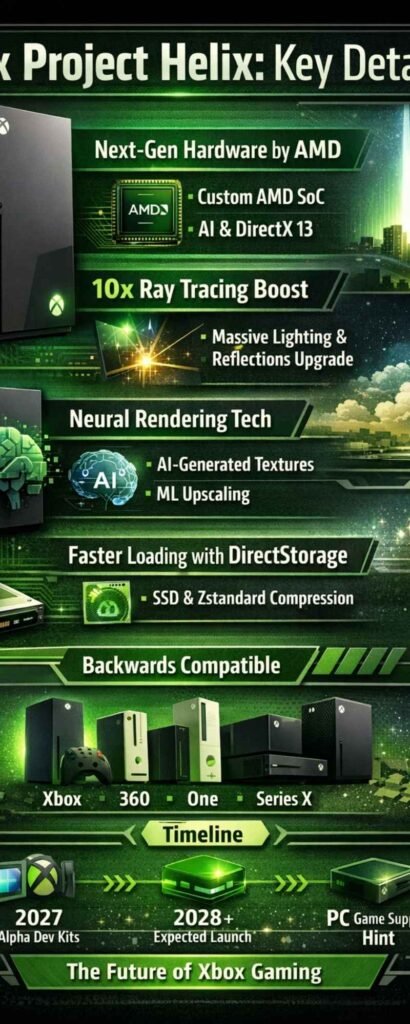
Addressing attendees at GDC Festival of Gaming, VP, Next Generation, Jason Ronald said that the upcoming console would deliver significantly higher performance, advanced AI-powered rendering, and major ray tracing improvements. Microsoft is developing the system with long-time partner Advanced Micro Devices (AMD) to design a custom system-on-chip (SoC).
While the console is still years away from release, Microsoft confirmed that developers may receive alpha hardware around 2027, signaling that the next Xbox generation is already deep in development.
Read More: Microsoft Outage: Flights Halted, Business impacted due to widespread global IT breakdown
Key Takeaways
Q: What is Project Helix?
Project Helix is the codename for the next Xbox console currently being developed by Microsoft.
Q: Who is building the hardware?
Microsoft is collaborating with AMD to create a custom SoC designed for next-generation graphics and AI rendering.
Q: How much performance improvement is expected?
Xbox says the console could deliver “an order of magnitude leap” in ray tracing performance compared with current systems.
Q: When will developers get access to the hardware?
Alpha development kits are expected around 2027.
Q: Will older Xbox games still work?
Yes. Microsoft confirmed continued support for games from four generations of Xbox consoles.
Next-Gen Hardware: Custom AMD Architecture
Project Helix will be powered by a custom AMD-based system-on-chip, built specifically for the next generation of DirectX technologies.
The chip is expected to introduce several major advancements:
- AI-assisted rendering pipelines
- Neural-based graphics techniques
- Deep texture compression
- Enhanced simulation capabilities
According to Ronald, traditional rendering methods are reaching their limits. New approaches—especially those powered by machine learning—will define future game visuals.
These include:
- Neural materials
- AI-generated textures and assets
- ML-based super resolution
- Advanced upscaling technologies
These techniques allow games to render more complex worlds while reducing the strain on hardware.
Ray Tracing Could Improve by 10×
One of the biggest promises for Project Helix is dramatically improved ray tracing performance.
Ray tracing simulates how light behaves in the real world, producing more realistic:
- Reflections
- Shadows
- Global illumination
- Ambient lighting
Microsoft claims Helix will deliver “an order of magnitude” improvement, meaning ray tracing could potentially run up to ten times faster than current Xbox hardware.
If achieved, this could enable fully dynamic lighting environments and significantly more immersive worlds.
Faster Asset Streaming with DirectStorage
Microsoft also highlighted improvements to how games load and stream assets from storage.
The system will integrate:
- DirectStorage technology
- Neural texture compression
- Zstandard (Zstd) compression
These technologies allow games to stream data directly from the SSD to the GPU, reducing the need for large amounts of system memory.
Benefits include:
- Faster loading times
- Larger game worlds
- Reduced memory bottlenecks
Essentially, developers will be able to stream textures and assets on demand, enabling more detailed environments without increasing hardware requirements.
Backward Compatibility Remains a Priority
Microsoft also reaffirmed its commitment to backward compatibility.
According to the company, games from four generations of Xbox consoles will continue to remain playable on future hardware.
This includes titles from:
- Xbox (2001)
- Xbox 360
- Xbox One
- Xbox Series X
Microsoft also hinted that PC games could become accessible directly on Xbox hardware, suggesting deeper integration between the Xbox and Windows ecosystems.
Microsoft Says Gaming Is Central to Its Future
During an internal Q&A session, Satya Nadella reaffirmed Microsoft’s long-term commitment to gaming.
Nadella described video games as one of the company’s core identities, alongside:
- Platform development
- Software tools
- Enterprise technology
He also highlighted gaming’s influence on Microsoft’s wider technology ecosystem, including:
- Cloud infrastructure
- The Microsoft Windows platform
- GPU-based cloud servers
According to Nadella, Microsoft intends to remain “best-in-class” in gaming while expanding the role of games across its broader technology platforms.
How Developers Will Prepare for Project Helix
- Receive Alpha Hardware (Expected 2027)
Early development kits allow studios to begin optimizing games. - Adopt Neural Rendering Techniques
Developers will experiment with AI-generated materials and textures. - Integrate Advanced Compression Systems
Using Zstandard and neural compression to reduce asset sizes. - Optimize DirectStorage Streaming
Game engines will stream assets directly from SSD storage. - Enhance Ray Tracing Workflows
Studios can design lighting systems that fully utilize the new hardware.
Why Neural Rendering Could Change Game Graphics
Traditional game graphics rely heavily on pre-rendered textures and large memory budgets.
Neural rendering changes that by using AI models to generate visuals dynamically.
Think of it like procedural graphics powered by machine learning:
| Traditional Graphics | Neural Rendering |
|---|---|
| Pre-built textures | AI-generated materials |
| Large memory usage | Smaller data models |
| Static assets | Dynamic generation |
This could allow future games to feature:
- Larger worlds
- More realistic surfaces
- Better lighting
- Smaller download sizes
Common Questions
When will Project Helix release?
Microsoft hasn’t announced a launch date. With developer kits expected in 2027, the console could arrive around 2028–2029.
Will Xbox Series X games work on Helix?
Yes. Microsoft says it will maintain compatibility across four generations of Xbox games.
Will Helix replace Xbox Series X?
Eventually yes, but Series X will remain supported for years.
Could PC games run directly on Xbox?
Microsoft hinted at expanding access to PC titles on Xbox hardware, though details remain unclear.
Will AI play a bigger role in games?
Yes. Microsoft’s focus on neural rendering and machine learning suggests AI will become a core component of next-generation graphics.
Conclusion
Project Helix represents Microsoft’s vision for the next era of gaming hardware. By combining AI-powered rendering, advanced ray tracing, and faster storage streaming, the company aims to push game realism far beyond current consoles.
Although the hardware is still years away, the roadmap suggests that future Xbox systems will rely heavily on machine learning technologies and deeper integration with PC and cloud platforms.
For developers and players alike, Project Helix signals that the next leap in gaming may come not just from faster hardware—but from smarter rendering technologies.