

Arif Habib Consortium Buys 75% PIA stake for Rs135bn
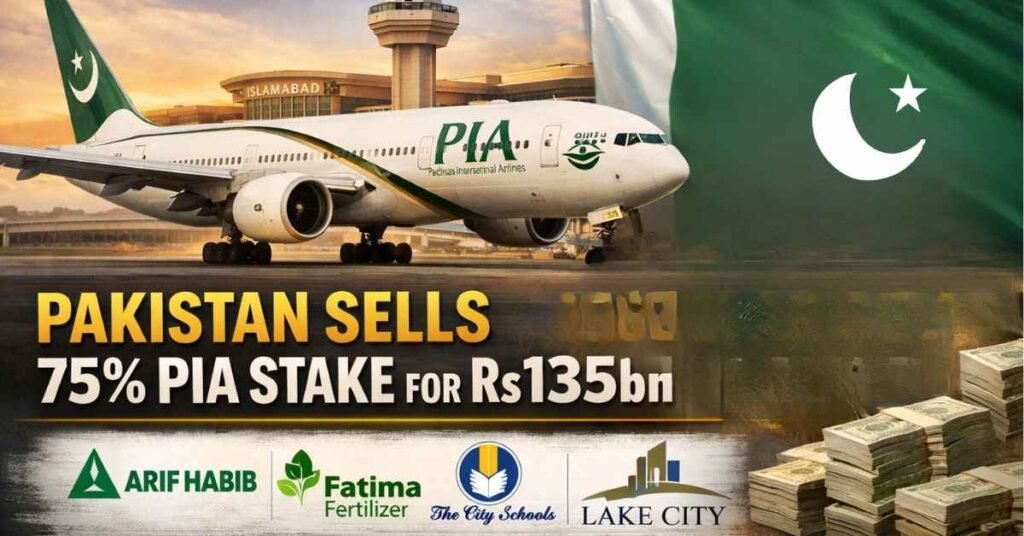
Pakistan on Tuesday finally sealed the sale of a 75% stake in Pakistan International Airlines for Rs135 billion while ending years of stalled privatisation attempts.
The government awarded management control of the loss-making flag carrier to the Arif Habib consortium after a group wins a bid through a competitive auction.
The winning group comprises of Arif Habib Corporation Limited, Fatima Fertiliser Company Limited, City Schools (Private) Limited and Lake City Holdings (Private) Limited.Govt Makes Second Effort To Privatize PIA
The transaction has marked Pakistan’s largest privatisation in around two decades which is a key milestone under Prime Minister Shehbaz Sharif’s economic reform agenda.
Officials said the auction concluded after a second-round open bidding process. The multiple offers exceeded the government’s minimum expected price of Rs100 billion.
In the first sealed-bid round, the Arif Habib consortium had offered Rs115 billion price while the Lucky consortium offered a bid Rs101.5 billion for the same stake.
A third bidder, the Air Blue–Lake City consortium, had submitted a significantly lower offer of Rs26.5 billion, which even failed to meet the threshold.
The competing bids had forced the auction into an open round with a base price of Rs100 billion, which was held in the presence of media and regulators.
During the final phase, the Arif Habib-led group raised its offer to Rs135 billion, against the the Lucky consortium’s last bid of Rs134 billion.
The Lucky group formally congratulated the winning bidder after exiting the auction.
The Privatisation Commission said the bidding had followed a transparent and rule-based framework which was approved by the Cabinet Committee on Privatisation and the federal cabinet.
Commission chairman Muhammad Ali said earlier that any bid above the reference price would automatically lead to an open auction to safeguard the public interest.
Under the transaction structure, 92.5% of the proceeds will be injected into Pakistan International Airlines. However, 7.5% will accrue directly to the federal government.
The government will retain a 25% minority stake, while keeping an option for the new owners to acquire it later under agreed terms.
The privatisation gives the consortium operational control of the airline which includes fleet, route planning, and commercial strategy.
According to the commission’s business plan, PIA’s operational fleet of 18 aircraft has been projected to double within three to four years.
The airline has been struggling for decades to survive with ageing aircraft, overstaffing, political interference, and chronic cash flow shortages.
Business leaders say PIA has accumulated losses of roughly Rs800 billion over the past 20 years which resulted in a persistent drain on public finances.
Analysts have noted that repeated government bailouts had not made any difference and rather failed to restore competitiveness against Middle Eastern and regional carriers.
Some restrictions were eased in recent years. But PIA continued to post operating losses amid rising fuel costs and weak balance sheet support.
The government’s earlier attempt to privatise the airline collapsed last year as investors had not shown appetite due to unresolved legacy liabilities.
At that time, Blue World City consortium, the sole bidder, had refused to raise its Rs10 billion offer for a 60% stake, which was well below expectations.
Pakistan has pursued privatisation of state-owned enterprises to meet commitments under a $7 billion programme with the International Monetary Fund.
The IMF has been repeatedly urging Pakistan to cut fiscal risks posed by loss-making public entities, which included airlines, power utilities and steel mills.
The Arif Habib group has experience across cement, energy, fertiliser and financial services. But aviation has remained a new venture.
Analysts said that Pakistan has successfully executed its first major privatisation deal in nearly two decades with the sale of Pakistan International Airlines (PIAA), concluding the transaction at a value of Rs135bn (US$480mn). This ranks among the largest privatisation deals in Pakistan’s history and marks a significant milestone in the government’s reform agenda.
The winning bid was submitted by the Arif Habib Consortium (AHC), led by Arif Habib Corporation Limited. The consortium includes Fatima Fertiliser Company Limited, AKD Group, City Schools, and Lake City Holdings Limited.
The transaction involved the divestment of an upfront 75% stake in PIAA. The remaining 25% has been structured as a three-month call option for the new investor at a 12% premium, with payment to be completed within 12 months.
Of the total bid value, 92.5% will be injected directly into the PIAA business, while the remaining 7.5% will be transferred to the government or the airline’s holding company. The large reinvestment into the airline reflects the high capital expenditure required to turn around the national carrier and expand its fleet size.
Under the deal structure, the consortium is allowed to add up to two additional investors, subject to meeting stringent eligibility criteria and obtaining government approval. The winning consortium may also induct new partners who were not part of the original bidding group.
In the first round of bidding, the Lucky Cement Consortium submitted a bid of Rs101.5bn (US$362.5mn). The Arif Habib Consortium offered Rs115bn (US$411mn), while the Air Blue Consortium bid Rs26.5bn (US$94.6mn).
The reference price approved by the privatisation committee was set at Rs100bn. As two bids exceeded this threshold, the auction progressed to a second round, with the Lucky Cement Consortium and Arif Habib Consortium qualifying for further bidding.
The second round commenced with a base price of Rs115bn, matching the highest bid from the first round. The bidding rules allowed a minimum increment of Rs250mn per bid.
The second round concluded at a final bid value of Rs135bn, representing a 35% premium over the reserve price of Rs100bn. After multiple bidding rounds, the Arif Habib Consortium emerged as the highest and winning bidder.
In our view, the final bid significantly exceeded market expectations, which were largely in the range of Rs80–100bn. The turnaround potential of PIAA remains substantial due to its landing rights across 78 destinations and access to 170 airport slots worldwide. The airline also carries strategic value as the national carrier of the world’s fifth most populous country.
We had earlier highlighted the privatisation of PIAA in our Annual Strategy 2026 as a key trigger for the equity market potentially reaching the 203,000 index level by December 2026. In our assessment, the successful sale of PIAA is likely to boost confidence within the privatisation ministry and set the tone for upcoming divestments, particularly in the power distribution companies (DISCOs),” Topline analysts said.