

Baker Links 25 U.S. ICT Firms with Pakistan
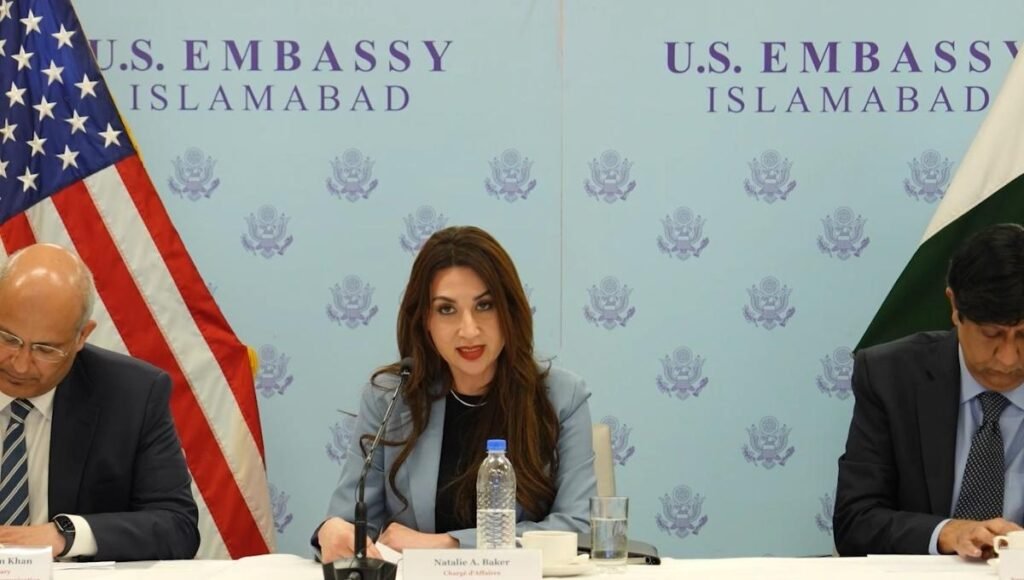
United Embassy in Pakistan has connected American technology companies with Pakistani officials to pursue investment and partnerships in cloud, AI and digital infrastructure.
U.S. Chargé d’Affaires Natalie A. Baker on February 12 connected 25 American information and communication technology companies with senior Pakistani officials to explore commercial partnerships in Pakistan’s expanding IT sector.
Federal Secretary for Information Technology and Telecommunication Zarar Hasham Khan joined the virtual session alongside Special Technology Zones Authority Chairman Azfar Manzoor and Special Investment Facilitation Council Project Director Syed Hadi. The officials outlined regulatory reforms, investment incentives and digital policy measures designed to attract foreign capital into Pakistan’s technology ecosystem.
Read More: US Announces $1.3B for Rekodiq Gold and Copper Project
Baker said the U.S. Mission in Pakistan remains committed to strengthening bilateral economic ties. She said cooperation could unlock Pakistan’s IT potential while creating new opportunities for American firms seeking growth markets. The embassy and consulates would assist companies in identifying local partners and navigating regulatory frameworks, she added.
The discussion highlighted commercial prospects in cloud computing, data centers, cybersecurity and artificial intelligence. These segments are expanding globally as enterprises shift toward digital infrastructure and automation. Pakistan aims to position itself within these value chains by leveraging a young workforce and competitive operating costs.
According to the Pakistan Software Export Board, IT and IT-enabled services exports reached about $2.6 billion in fiscal year 2023. The sector has recorded more than 100% growth over five years, supported by rising freelance services and software development demand. The State Bank of Pakistan has repeatedly cited IT exports as a key source of stable foreign exchange inflows during periods of external account stress.
Pakistan’s telecommunication base has expanded steadily. Data from the Pakistan Telecommunication Authority shows mobile broadband subscribers exceeded 127 million by late 2024. Fourth-generation coverage now spans most urban centers, while fiber deployment continues in major cities to support data-intensive services.
Officials said the Special Technology Zones Authority offers income tax holidays of up to 10 years and customs duty exemptions on imported capital goods. These incentives aim to reduce startup costs for foreign technology investors. Several technology parks are under development to provide plug-and-play facilities for domestic and international firms.
The Special Investment Facilitation Council, formed in 2023 to accelerate strategic investments, is streamlining approvals in sectors including IT and telecommunications. The council was established to cut bureaucratic delays and coordinate between federal and provincial authorities. Policymakers view digital infrastructure as central to long-term economic stability and export diversification.
Bilateral trade between the United States and Pakistan totaled about $7.3 billion in 2023, according to data from the Office of the U.S. Trade Representative. While textiles dominate goods exports, services trade has gained traction in recent years. Analysts say technology collaboration could rebalance trade toward higher value-added services.
Baker noted that the United States will mark its 250th anniversary in 2026, highlighting American leadership in innovation and technology. She said the technology sector exemplifies U.S. ingenuity and global competitiveness. The engagement formed part of the Direct Line for American Businesses program, which links U.S. firms directly with foreign government officials.
This was the third Direct Line session led by Baker and the U.S. Mission in Pakistan over the past year to deepen commercial engagement. Pakistan’s government is also advancing data protection legislation and fintech regulatory frameworks to align with global standards. As Islamabad pushes to raise annual IT exports toward $5 billion, sustained U.S. participation could play a pivotal role in shaping Pakistan’s digital economy trajectory.