
Experts Urge Bankable Policy to attract Chinese solar Manufacturers
Experts have urged the government to introduce a bankable policy to attract Chinese solar manufacturers.
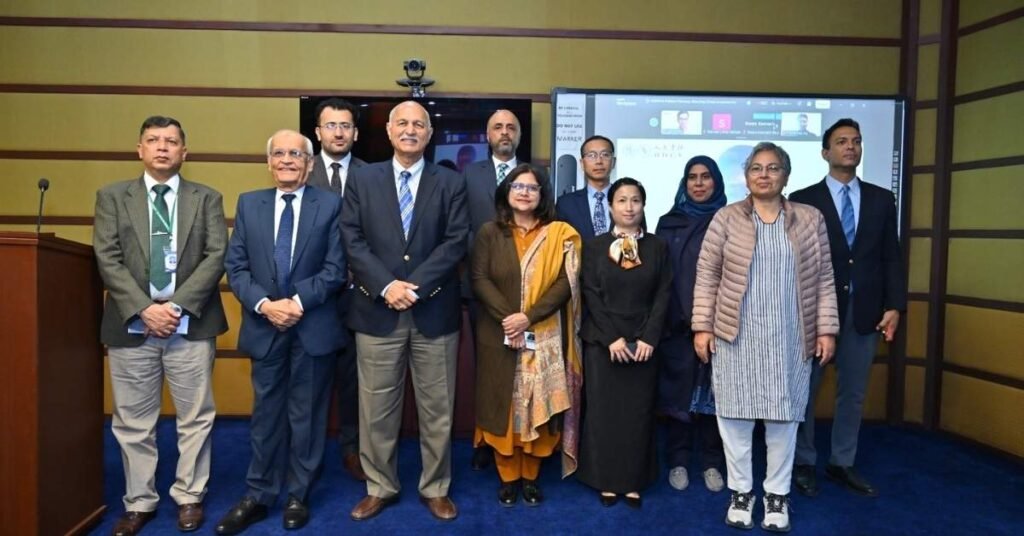
The Pakistan-China Institute convened a regional conference titled “ASEAN-to-Pakistan Pathways: Attracting Chinese Investment for Solar PV Value-Chain Manufacturing” under the Green CPEC Alliance, aimed at converting Pakistan’s solar import surge into domestic manufacturing capacity.
Policymakers and regional experts gathered to translate ASEAN’s solar manufacturing experience into actionable lessons for Pakistan. The dialogue focused on how to make investment decisions bankable amid shifting global trade and industrial policies.
Read More: New Renewable Policy promises One Window Facility
Mustafa Hyder Sayed, Executive Director of the Pakistan-China Institute, opened the conference by outlining strategic shifts reshaping solar manufacturing and investment flows. He cited global and regional rebalancing, post-tariff adjustments in ASEAN, and China’s expanding overseas cleantech push.
He said the Green CPEC Alliance convened the forum as countries compete to attract mobile solar PV value-chain investment through credible industrial policy and delivery capacity. He stressed that clarity of policy packages, readiness of special economic zones, and alignment between facilitation and execution determine investor confidence.
Senator Mushahid Hussain Sayed, Chairman of the Pakistan-China Institute, said Pakistan’s solar growth is increasingly tied to China’s industrial power. He cited imports of around 17 GW of solar panels in 2024 and about 17.9 GW in FY25, taking cumulative imports beyond 50 GW by September 2025.
He said Pakistan’s share in China’s solar exports rose to about 12% in 2025 from roughly 2% in 2022. He described cheap Chinese solar modules as a one-time strategic window, noting global solar installations reached about 597 GW in 2024 while module prices fell to $0.07–$0.09 per watt in 2024 and early 2025.
He cautioned that production cuts and policy shifts could push prices up by nearly 9% by late 2025. He said China controls over 80% of global solar manufacturing capacity, backed by more than $50bn in investment and around 300,000 jobs.
He linked solar geopolitics to water and resource pressures inside Pakistan. He cited about 283,000 net-metering consumers by December 2024 and 2.8–4.1 GW of net-metered capacity. He also noted around 650,000 solar-powered tube wells and a 30% expansion in rice cultivation since 2023, raising water security and mineral dependency concerns.
Dr. Shezra Mansab Ali Kharal, Minister of State for Climate Change, said Pakistan’s solar demand shock remains heavily import-driven. She cited approximately 51.5 GW of solar modules imported from China by November 2025, including about 16.6 GW in 2024 and just over 10 GW in the first four months of 2025.
She said deployment is now largely behind-the-meter, with estimates of 27–33 GW installed across segments. Official net-metering capacity reached 6.8 GW by September 2025, up from more than 2.2 GW and over 156,372 prosumer facilities as of June 2024.
She said solar supplied 25.3% of Pakistan’s utility electricity between January and April 2025. She warned of emerging “negative daytime demand” signals in Lahore, Faisalabad, and Sialkot, increasing pressure for tariff and market reforms.
She said module prices fell to about $0.08 per watt by 2025, while customs valuation reset to $0.08–$0.09 per watt. She framed local manufacturing as a foreign exchange and value-retention imperative, noting solar import costs exceeded $2bn by June 2025.
Muhammad Umar Farooq, Senior Research Associate at the Institute, said trade policy, industrial strategy, and geopolitics now shape solar investment decisions as much as cost. He said major markets are encouraging supply-chain diversification away from single-country concentration.
He said ASEAN succeeded by combining incentives with execution speed and export logic. He stressed that bankability requires enforceable commitments, not policy announcements.
Dr. Christoph Nedopil of Griffith Asia Institute said ASEAN became attractive through credible facilitation and execution readiness. He urged Pakistan to close gaps in policy stability, SEZ execution, logistics, and investor risk protection.
N. A. Zuberi of CSAIL said investors prioritize speed, certainty, and enforceability over headline incentives. He warned that policy promises can backfire when approvals and infrastructure lag behind timelines.
Dr. Marlistya Citraningrum of IESR said Indonesia’s experience shows the need to balance local content ambitions with investability. She stressed sequencing and predictability to avoid deterring foreign manufacturers.
Lam Pham of Ember said ASEAN attracted Chinese firms through tariff-jumping foreign direct investment to bypass anti-dumping and anti-subsidy measures. He cited trade agreements, supply-chain proximity, fiscal incentives, and industrial ecosystem readiness as critical factors.
He advised Pakistan to focus on “invest this year, operate this year” execution. He recommended diversifying export markets amid shifting trade barriers, investing in research and development, and adopting a staged move from modules to cells and wafers.
Dr. Erfa Iqbal of the Board of Investment acknowledged execution bottlenecks in SEZs. She said reforms within six to twelve months could improve delivery certainty and reduce approval friction.
Xu Tianqi of RDCY said manufacturing decisions depend on risk, returns, and execution certainty despite CPEC branding. He said credible risk protection and dependable implementation are essential to attract Chinese private manufacturers.
Mark Lister of Asia Clean Energy Partners said Pakistan’s PV boom signals strong demand but manufacturing needs long-term policy certainty. He proposed a phased strategy starting with module assembly, mounting structures, balance-of-system components, and possibly inverters, before moving into polysilicon, wafers, and cells.
He emphasized workforce upskilling, industrial clustering, recycling opportunities, and structured collaboration with Chinese stakeholders. Linh Hua of Vietnam’s Ministry of Energy shared lessons on revenue certainty, grid integration, curtailment risk, and permitting reforms to enhance project bankability.
The conference drew participants from think tanks, media, policymakers, and the private sector. Speakers agreed that Pakistan’s solar surge offers a narrow window to anchor value-chain investment domestically, provided policy credibility and execution match ambition under the Green CPEC Alliance.