

Girls’ Education Statistics and Trends Report 2023–24 released
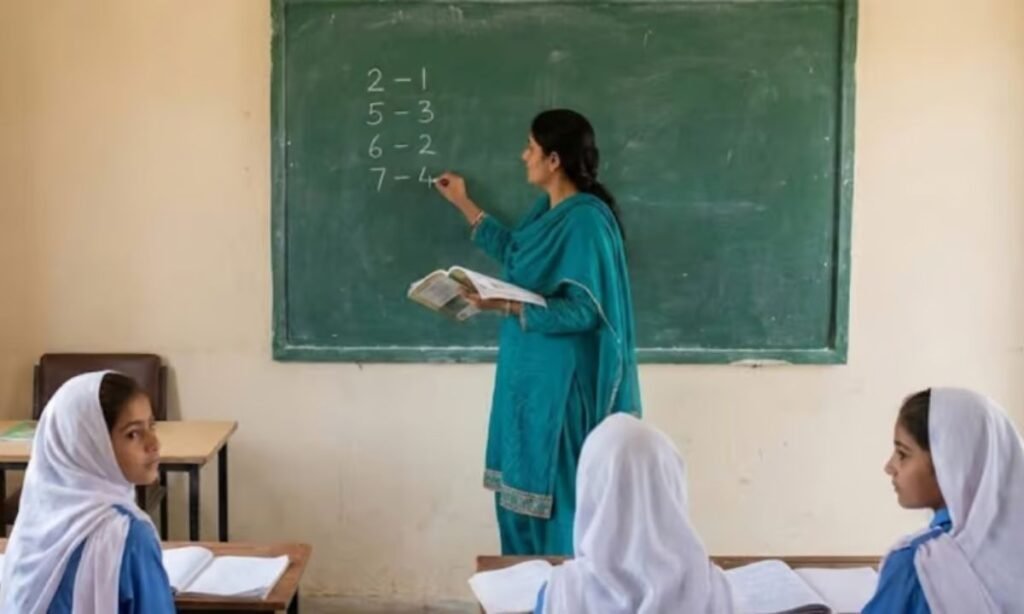
Federal Minister for Education and Professional Training, Khalid Maqbool Siddiqui, has officially launched the Girls’ Education Statistics and Trends Report 2023–24.
The report reveals significant progress in girls’ education across Pakistan, while also highlighting persistent challenges.According to the report, 96% of schools are housed in permanent buildings, 92% have functional toilet facilities, and 82% provide access to clean drinking water.
However, issues such as malnutrition—leading to stunted growth and underweight children—remain areas of concern.
The primary school completion rate for girls has increased from 75% to 89%, reflecting steady improvements in educational access, facilities, and infrastructure each year.The launch ceremony of the Girls’ Education Statistics and Trends Report 2023–24 was held at the Pakistan Institute of Education (PIE).
The report was prepared collaboratively by PIE, the Malala Fund, PAGE, and the Ministry of Education. The event was attended by Federal Minister Khalid Maqbool Siddiqui, Minister of State for Education and Professional Training Wajiha Qamar, Federal Parliamentary Secretary Farah Akbar Naz, Senator Fauzia, Director General PIE Dr. Muhammad Shahid Soroya, along with representatives of partner organizations and education experts.
While sharing his views on the findings, Minister Khalid Maqbool Siddiqui stated that the data presented in the report would serve as a foundation for future policymaking. He emphasized that without accurate data, effective problem-solving is impossible. “History shows that no country progresses in isolation; entire regions advance together.
Now that we have reliable data, we must move toward practical action, as successful global policies have been built on strong statistical foundations,” he remarked.
He further stated that preventing girls from dropping out of school requires changing societal attitudes and broadening mindsets. Highlighting Pakistan’s demographic profile, he noted that the country has 140 million young people and stressed the need to decide whether this youth population is to be considered a burden or transformed into an asset by providing opportunities.
“The fight against ignorance must begin at home. When the state places a degree or a skill in a girl’s hand, it is her right to be allowed to move forward,” he added. While acknowledging traditional domestic responsibilities, he urged parents to also allow their daughters to pursue professional careers, stating that confining skilled women to homes results in a significant loss of human capital.In his concluding remarks, the Federal Minister said that serious measures for girls’ education are now an urgent national priority, and the government will utilize all available resources in this regard.Minister of State Wajiha Qamar highlighted key aspects of the report and stated that an action plan would be developed. She noted that both the achievements and challenges identified would help chart a new course for future reforms.
DG PIE Dr. Muhammad Shahid Soroya remarked that Pakistan’s daughters are demonstrating exceptional abilities in academics. According to the National Achievement Test (NAT) 2023 results, girls outperformed boys in English, Urdu/Sindhi, and Mathematics. In Grade 8, they also excelled in Science and Mathematics. He explained that the purpose of compiling such data is to identify systemic gaps hindering girls’ progress, thereby strengthening evidence-based policymaking.
The report further notes that due to population pressure, the number of schools per 1,000 children has declined. Regarding facilities for students with disabilities, only 23% of schools have ramps, and even fewer institutions provide special teaching materials or assistive devices.Additionally, only 23% of teachers in girls’ schools have received foundational training, and 19% of schools are equipped with digital devices.
The share of the education budget has decreased from 13% to 11%, with 94% of total funds being spent on salaries, leaving minimal space for development expenditures.While women’s enrollment in higher education is approaching parity with men, their participation in the workforce stands at only 24%, representing a substantial loss of human capital.The report also reveals that 26.2 million children remain out of school in Pakistan, including 13.4 million girls. Although girls have demonstrated their potential, systemic weaknesses continue to obstruct their educational journey.
Education experts concluded that the findings confirm the talent and capability of Pakistani girls. However, to ensure their success, the government must prioritize increasing the education budget, modernizing teacher training, and expanding digital facilities nationwide.