

Govt Raises Petrol, Diesel Prices by Rs55
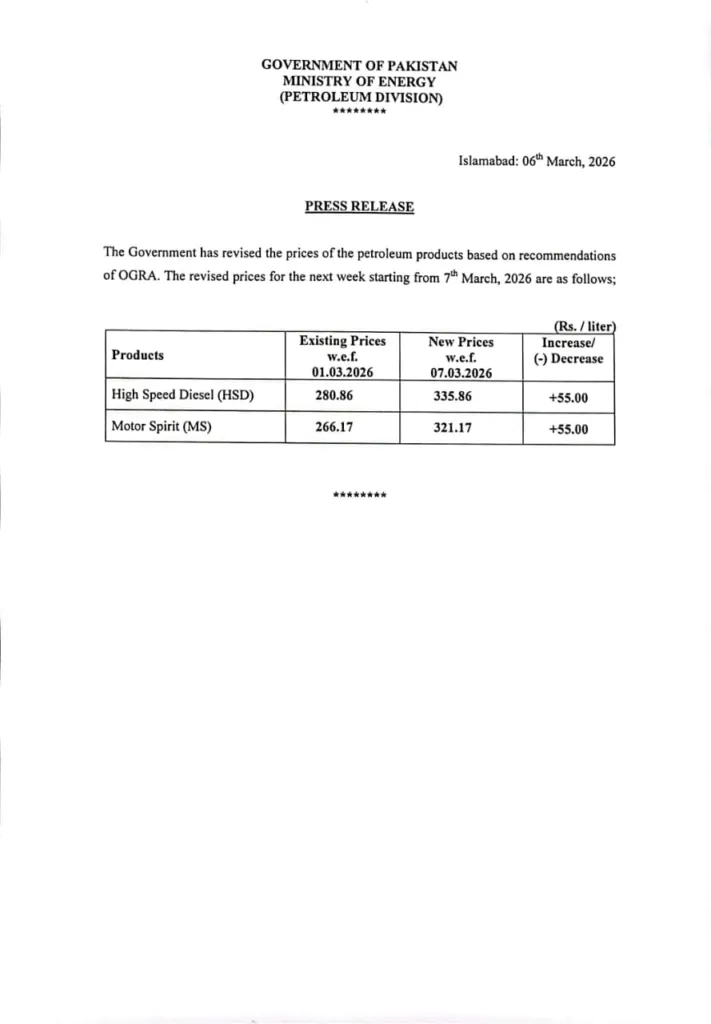
The government on Friday made a massive increase in petrol and diesel prices by Rs55 per litre each amid tension in the gulf region effective from March 7, 2026.
The new price of petrol has been set at Rs321 per litre.
The price of high-speed diesel has been increased to Rs335 per litre.
Kerosene oil price has been increased by Rs130 per litre to Rs319 while light diesel oil price has been increased by Rs68 to Rs235 per liter.
The crude oil price in the international market touched $90 per barrel causing higher increase in prices of petroleum products in Pakistan.
Iran has closed the Hormuz strait which led to suspension of oil and LNG supplies from Middle east countries. It had led to sharp increases in prices of petroleum products.
Analysts believed that crude oil prices would cross $100 per barrel if the current situation in the Gulf region continues.
The government had increased the price of petrol by Rs8 per litre with effect from March 1, 2026. It had also raised the price of diesel by Rs5.16 per litre for the next fortnight, up to March 15.
But the government decided to review the oil prices on a weekly basis shifting from fortnightly basis in order to avoid the hoarding of petroleum products.
Oil marketing companies (OMCs) had posted a combined sales of over one million tonnes of petrol and diesel during February 2026.
Read More: Petrol Pumps Must Install Digital Fuel Monitoring
Petrol had recorded sales of 588,000 metric tonnes, The diesel sales had reached 476,000 metric tonnes during the month.
The daily sale volume of petrol also amounted to 21,000 metric tonnes. The High-Speed Diesel sales were also recorded at 17,000 metric tonnes per day.
The unannounced rationing of petrol has begun in the twin cities, like rest of the country amid closure of strait of Hurmuz by Iran.
As tensions spread across the region in wake of US and Israeli aggression on Iran, the consumer too initiated panic buying on Thursday and Friday.
As a result a large number of petrol stations mainly belonging to Aramco and Attack Petroleum Ltd went dry as their petrol stocks were sold off by Friday evening.
Whereas, stations belonging to Shell, PSO have started rationing of petrol selling between 8 to 10 liters only per vehicle.
The situation faced in Rawalpindi and Islamabad was the same as witnessed in other areas of Punjab and Khyber Pakhtunkhwa.
As a result, by Friday evening
long queues of cars and motorcycles were witnessed at filling stations.
Muhammad Irfan, a manager of a petrol filling station, said that people are in panic and most of them were buying additional quantities of petrol possibly after some social media posts.
Whereas the consumers have their own reasonings.
Shiraz Hussain, a motorcyclist in Chaklala Scheme-III, said he wanted to get petrol as there were reports that prices would further increase on Friday night, so he decided to fill his tank.
While, Muhammad Bilal, a motorist on Murree Road, said he visited different filling stations to get fuel but there was a shortage.
He said he later went to a petrol filling station near Faizabad where vehicles had queued up on the main road and finally got fuel after waiting for one hour.
On the other hand Pakistan Petroleum Pumps Owners Association spokesman Noman Butt said that supply from oil marketing companies had been slow.
He said the prime minister had issued a statement about taking action against petrol pump owners but had failed to take action against petroleum
companies that slowed down the supply.
While, there are reports that some filling stations too were hoarding petrol in anticipation of making inventory gains.
One consumer Ahmed Zafar could not find petrol for his motorcycle, but later after intervention of his father’s influence the pump management gave him 10 liters.
“The new petrol price is set to be announced late Friday night, it seems that many filling stations were hoarding petrol, ” Ahmed said.
Responding to the query, Hassan Shah a senior member of Petroleum Dealers Association said that the average storage capacity of each pump was around 25,000 to 30,000 liters for petrol.
“the petrol pumps cannot create any artificial shortage, because this storage capacity accounts to around Two days of sale, ” Hassan Shah added.
He added that the oil companies have failed to manage the situation, and the government should take them to task instead of sealing filling stations