

Pakistan’s Upstream Sector Records Modest Growth in Early 2026
Pakistan’s upstream energy sector recorded modest growth in oil and gas production in early 2026, while exploration activity showed mixed signals.
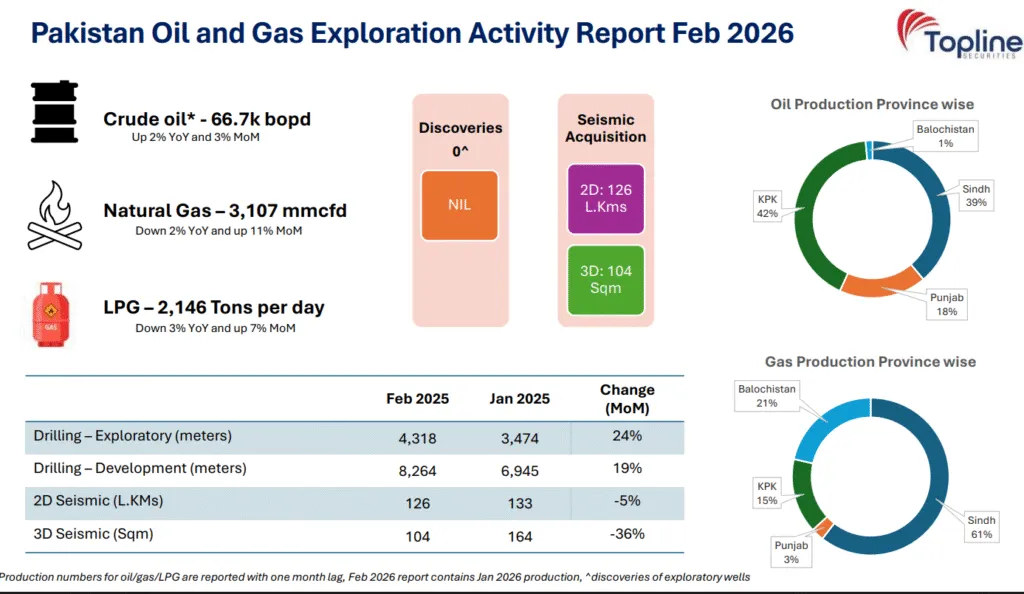
According to the Pakistan Oil and Gas Exploration Activity Report – February 2026, released by Topline Security, crude oil production rose 2% year-over-year and 3% month-over-month, reaching 66.7 thousand barrels per day (bopd). Meanwhile, natural gas output increased 11% month-over-month, although it remains slightly below last year’s levels.
Read More: Pakistan Awards 11 Oil & Gas Blocks
Despite these gains in production, exploration indicators such as 3D seismic acquisition dropped significantly, highlighting a slowdown in certain exploration activities. This article analyzes the latest exploration metrics, production trends, provincial contributions, and what they mean for Pakistan’s energy outlook.
Key Takeaways
Q1: How much oil does Pakistan currently produce?
Pakistan produced 66.7 thousand barrels per day (bopd) in the latest report period, showing 2% YoY growth and 3% MoM growth.
Q2: What is the current natural gas production level?
Natural gas output stands at 3,107 million cubic feet per day (mmcfd), down 2% YoY but up 11% MoM.
Q3: Did Pakistan discover any new oil or gas fields in February 2026?
No new discoveries were reported from exploratory wells during the period.
Q4: Which province produces the most oil?
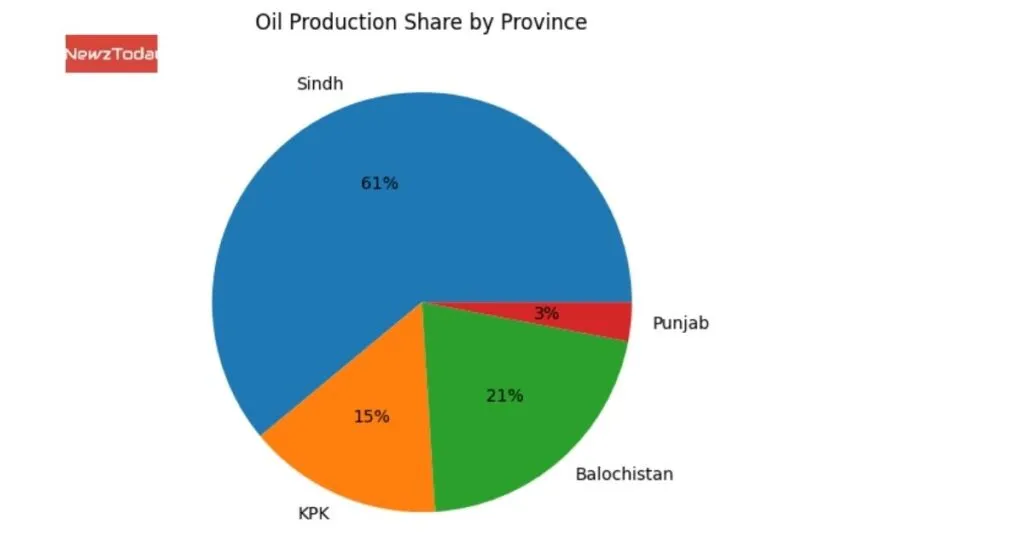
Sindh leads oil production with 61%, followed by Khyber Pakhtunkhwa (15%), Balochistan (21%), and Punjab (3%).
Q5: What happened to seismic exploration activity?
2D seismic surveys fell slightly while 3D seismic acquisition declined by 36% month-over-month.
Exploration Activity Trends
Pakistan’s upstream sector recorded increased drilling activity, indicating ongoing development in producing fields.
Drilling Activity
| Activity | Feb 2026 | Jan 2026 | MoM Change |
|---|---|---|---|
| Exploratory Drilling | 4,318 meters | 3,474 meters | +24% |
| Development Drilling | 8,264 meters | 6,945 meters | +19% |
The rise in drilling activity suggests operators are prioritizing development wells, which help boost output from existing discoveries rather than exploring new frontier areas.
Seismic Survey Activity
| Seismic Type | Feb 2026 | Jan 2026 | MoM Change |
|---|---|---|---|
| 2D Seismic | 126 line km | 133 line km | -5% |
| 3D Seismic | 104 sq km | 164 sq km | -36% |
The sharp decline in 3D seismic surveys could indicate:
- Budget adjustments by exploration companies
- Completion of prior seismic programs
- Shift toward development drilling instead of new exploration campaigns
Pakistan’s Oil, Gas, and LPG Production
Crude Oil
- Production: 66.7k barrels per day
- YoY Change: +2%
- MoM Change: +3%
Oil output growth reflects improved production from mature fields and development drilling.
Natural Gas
- Production: 3,107 mmcfd
- YoY Change: -2%
- MoM Change: +11%
While monthly output increased, the year-over-year decline reflects depletion at aging gas fields, a persistent challenge for Pakistan’s energy sector.
LPG Production
- Production: 2,146 tons per day
- YoY Change: -3%
- MoM Change: +7%
LPG production improved on a monthly basis but remains below last year’s levels.
Provincial Contribution to Oil & Gas Output
Oil Production Share
| Province | Share |
|---|---|
| Sindh | 61% |
| Khyber Pakhtunkhwa | 15% |
| Balochistan | 21% |
| Punjab | 3% |
Sindh continues to dominate oil production due to major fields in the Lower Indus Basin.
Gas Production Share
| Province | Share |
|---|---|
| Khyber Pakhtunkhwa | 42% |
| Sindh | 39% |
| Punjab | 18% |
| Balochistan | 1% |
Khyber Pakhtunkhwa leads gas output largely due to northern gas basins and mature producing fields.
How Oil & Gas Exploration Works in Pakistan
Understanding the upstream process helps explain why seismic activity and drilling numbers fluctuate.
1. Geological Survey
Companies analyze rock formations using historical data and geological mapping.
2. Seismic Data Acquisition
2D and 3D seismic surveys map underground structures to identify potential hydrocarbon traps.
3. Exploratory Drilling
Test wells are drilled to confirm whether oil or gas exists.
4. Discovery Evaluation
If hydrocarbons are found, the reservoir size and commercial viability are assessed.
5. Development Drilling
Additional wells are drilled to increase production.
6. Production Phase
Hydrocarbons are extracted and transported to processing facilities.
Expert Insight: Why Pakistan’s Exploration Activity Fluctuates
From an energy market analysis perspective, Pakistan’s upstream activity often fluctuates due to three key factors:
1. Declining Mature Fields
Many large gas fields discovered decades ago are now naturally depleting, reducing output despite development drilling.
2. Investment Constraints
Exploration requires significant capital investment. Economic conditions and policy frameworks can influence how aggressively companies explore.
3. Regulatory and Security Factors
Exploration activity in certain regions—particularly frontier basins—can slow due to logistical, regulatory, or security challenges.
Because of these factors, Pakistan frequently experiences periods of stable production but inconsistent exploration growth.
Common Questions
Why was there no new oil or gas discovery?
Exploration success rates can be unpredictable. Even with drilling activity, commercial discoveries are not guaranteed.
Why did seismic activity drop sharply?
Seismic campaigns often run in phases. A 36% drop in 3D seismic work may simply reflect the completion of earlier surveys.
Does higher drilling mean higher production?
Usually yes—especially development drilling, which focuses on increasing output from known reservoirs.
Why is Sindh the largest oil producer?
The province hosts most of Pakistan’s mature oil fields and exploration infrastructure.
Is Pakistan increasing domestic energy production?
The latest report suggests modest growth in oil output and short-term gas improvement, though long-term supply challenges remain.
Conclusion
The Pakistan Oil and Gas Exploration Activity Report (Feb 2026) shows a mixed picture for the country’s upstream energy sector. Oil production continues to grow modestly, and natural gas output improved month-over-month. However, the absence of new discoveries and a significant drop in seismic activity highlight ongoing exploration challenges.
For Pakistan’s long-term energy security, consistent exploration investment and new discoveries will be crucial to offset declining production from mature fields.